Table of Contents
Introduction
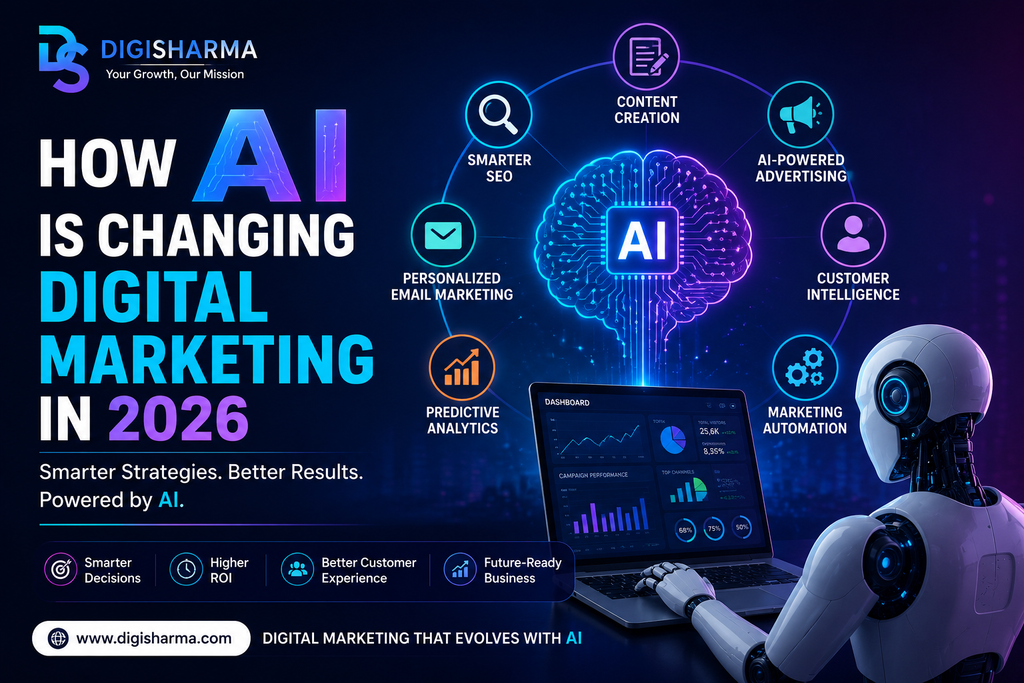
AI is changing Digital Marketing faster than ever, and AI in digital marketing is one of the biggest reasons behind this transformation.
Artificial intelligence is no longer limited to chatbots or content-writing tools. In 2026, AI is influencing how businesses understand customers, create content, manage advertising campaigns, analyse data, personalise experiences and generate leads.
Search itself is also changing. Google says its AI Overviews now reach more than 2.5 billion monthly active users, while AI Mode has surpassed 1 billion monthly users. Google also reports that its AI-powered Search features are increasing overall search activity and sending billions of clicks to websites every week.
For businesses, this creates both an opportunity and a challenge.
Businesses that learn to combine AI in digital marketing with human creativity, strategy, and customer understanding can build stronger brands and achieve better marketing efficiency.
What Is AI in Digital Marketing?
AI in digital marketing means using artificial intelligence to support or automate different marketing activities.
AI can analyse huge amounts of information, identify patterns and help marketers make faster decisions.
It can be used for:
• Search engine optimisation (SEO)
• Content creation
• Paid advertising
• Social media marketing
• Customer segmentation
• Lead generation
• Email marketing
• Data analysis
• Website personalisation
• Marketing automation
• Predictive analytics
The important point is that AI does not simply replace marketing work.
It is becoming a powerful assistant that helps marketers spend more time on strategy, creativity and business growth.
How AI Is Changing Digital Marketing in 2026
- AI Is Transforming SEO
SEO is moving beyond traditional keyword optimisation.
People increasingly use conversational and complex queries, while search engines use AI to understand search intent and provide richer answers.
Google’s AI Mode is designed for more conversational searches, including longer and more complex questions.
This means modern SEO needs to focus on:
• Search intent
• High-quality original content
• Topic authority
• Helpful answers
• Natural language
• Strong website structure
• Trust and credibility
• User experience
In 2026, successful AI SEO is not about stuffing keywords into pages. It is about creating content that genuinely answers what users are trying to discover.
- AI Is Making Content Marketing Faster
One of the most visible applications of AI in digital marketing is content creation.
AI tools can help marketers generate ideas, research topics, create outlines, improve headlines, repurpose content and produce initial drafts.
However, publishing completely generic AI-generated content is not a strong strategy.
Human input still matters because audiences want:
• Original ideas
• Real examples
• Experience
• Personality
• Brand voice
• Expert opinions
• Useful solutions
The best approach is AI + human creativity.
AI can help you work faster, while a skilled marketer ensures the content remains accurate, useful, engaging and aligned with the brand.
- AI Is Changing Google Ads and PPC Advertising
Paid advertising is becoming increasingly automated.
Google’s Performance Max campaigns use AI for bidding, audiences, creative optimisation and other campaign decisions. Google also describes AI Max for Search as a suite of targeting and creative features designed to optimise Search campaigns continuously.
In practical terms, advertisers can use AI to help:
• Identify valuable audiences
• Adjust bids
• Match ads to relevant searches
• Test creative variations
• Optimise campaigns
• Find conversion opportunities
• Analyse performance data
Google’s 2026 advertising updates are also moving toward more conversational and AI-driven ad experiences within Search.
This makes professional campaign strategy even more important.
AI can optimise thousands of signals, but it still needs the right goals, conversion tracking, budget, creative assets and business data.
- AI Is Improving Lead Generation
Lead generation is another area where AI in digital marketing can make a major difference.
Instead of treating every visitor equally, AI can help businesses identify patterns in customer behaviour and determine which users are more likely to become leads or customers.
AI-powered systems can support:
• Lead scoring
• Customer segmentation
• Personalised landing pages
• Automated follow-ups
• Chatbots
• Email sequences
• Retargeting
• Customer journey analysis
Imagine a website visitor downloading a guide, returning several times and visiting your pricing page.
An AI-powered marketing system can identify that behaviour as a stronger buying signal and help move that prospect into the right follow-up journey.
That can make lead generation more systematic and efficient.
- AI Is Personalising Customer Experiences
Customers increasingly expect businesses to understand their needs.
AI helps marketers deliver more personalised experiences by analysing browsing behaviour, previous interactions, interests and engagement patterns.
For example, an e-commerce business can use AI to recommend products based on previous activity.
A service business can use behavioural data to show different website messages to different audience segments.
Personalisation can improve the customer journey by making marketing feel more relevant, not generic.
- AI Is Changing Social Media Marketing
Social media teams are also benefiting from AI in digital marketing.
AI can help marketers:
• Generate content ideas
• Create social media captions
• Repurpose long-form content
• Analyse engagement
• Identify trends
• Research audiences
• Test different messaging
• Organise content calendars
But successful social media marketing still requires human understanding.
People connect with stories, opinions, humour and authenticity.
AI can help produce content at scale, but your brand still needs a recognisable voice.
- AI Is Making Marketing Analytics Smarter
Data has always been important in digital marketing.
The difference in 2026 is that AI can make large amounts of data easier to interpret.
Google is adding AI-powered experiences to Google Ads and Analytics to help marketers uncover insights, create visual reports using prompts and benchmark performance.
Instead of spending hours manually reviewing dashboards, marketers can use AI to identify patterns and ask questions such as:
• Which campaigns are producing the best leads?
• Which audience is converting?
• Where are users dropping off?
• Which landing page performs better?
• Which channels are wasting budget?
The result is faster decision-making.
AI in Digital Marketing: Where It Creates the Most Impact
The following chart gives an illustrative view of potential marketing impact, rather than a universal industry benchmark.
Marketing Area Potential AI Impact Main Benefit
SEO High Search intent and content optimisation
PPC / Google Ads Very High Bidding and campaign optimisation
Content Marketing Very High Faster research and production
Lead Generation High Lead scoring and automation
Social Media High Ideation and content efficiency
Analytics Very High Faster insights and decision-making
Personalisation High More relevant customer experiences
A Simple 2026 AI Marketing Workflow
Data → AI Analysis → Strategy → Content/Ads → Personalisation → Conversion → Measurement → Optimisation
This cycle allows businesses to continuously learn from customer behaviour and improve marketing performance.
Why Human Expertise Still Matters
The growth of AI in digital marketing does not mean marketers are becoming unnecessary.
In fact, strategic expertise may become even more valuable.
AI can generate hundreds of ideas.
A good marketer knows which idea fits the business.
AI can analyse campaign data.
A good marketer knows what action to take.
AI can generate content.
A good marketer adds brand personality, experience and persuasive storytelling.
The future is not AI versus marketers.
It is AI plus skilled marketers.
How Businesses Can Prepare for AI Digital Marketing Trends in 2026
Businesses should not adopt AI simply because it is popular.
A better approach is to identify where AI can solve an actual marketing problem.
Start with these steps:
• Audit your existing digital marketing strategy.
• Identify repetitive marketing tasks.
• Improve your website’s content and technical SEO.
• Set up accurate conversion tracking.
• Use AI to support—not blindly replace—content creation.
• Test AI-powered advertising features.
• Analyse customer data more intelligently.
• Build a consistent brand voice across channels.
• Measure results before increasing investment.
The goal should be better marketing, not simply more automation.
How AI in Digital Marketing Can Help Small Businesses
Small businesses often have limited time, budgets and marketing resources.
That makes AI in digital marketing particularly useful.
A small business can use AI-assisted processes to compete more efficiently in areas such as:
• Local SEO
• Google Ads
• Social media
• Website content
• Lead generation
• Email marketing
• Customer follow-ups
However, tools alone do not create growth.
Businesses need a clear marketing strategy, strong positioning, accurate targeting and consistent execution.
That is where professional digital marketing services can make a difference.
The Future of AI in Digital Marketing
The direction is clear: marketing is becoming more automated, conversational, personalised and data-driven.
Google’s 2026 marketing updates show that AI is increasingly being integrated across Search, advertising, analytics, creative optimisation and commerce.
This means digital marketers need to think beyond traditional channels.
The future will involve understanding how customers discover brands through search engines, AI experiences, social platforms, videos, websites and increasingly intelligent advertising systems.
Businesses that adapt early can build a competitive advantage.
Final Thoughts
AI in digital marketing is not a temporary trend.
It is becoming part of the everyday marketing process.
From AI SEO and content marketing to Google Ads, social media, lead generation and analytics, artificial intelligence is changing how businesses attract, engage and convert customers.
But technology alone is not enough.
The winning combination is smart technology + strong strategy + human creativity.
At DigiSharma, the focus is on using modern digital marketing methods to help businesses improve visibility, attract the right audience and generate meaningful growth.
Whether you need SEO, PPC, Google Ads, social media marketing, lead generation, branding, website development or graphic design, an AI-assisted strategy can help make your marketing more efficient and competitive.
The future of marketing is already here. The businesses that learn to use it strategically will be the ones best positioned to grow.
Frequently Asked Questions (FAQ)
- What is AI in digital marketing?
AI in digital marketing means using artificial intelligence to improve marketing activities such as SEO, advertising, content creation, lead generation, personalisation, social media and analytics. - How does AI help SEO?
AI can help marketers understand search intent, identify content opportunities, analyse data, optimise content and improve the overall customer search experience. SEO in 2026 increasingly needs to account for AI-powered search experiences. - Can AI replace digital marketers?
No. AI can automate and accelerate many marketing tasks, but human expertise remains essential for strategy, creativity, brand positioning, communication and decision-making. - How is AI changing Google Ads?
AI is increasingly involved in bidding, targeting, creative optimisation and campaign management. Google’s Performance Max and AI Max are examples of AI-powered advertising capabilities. - Is AI-generated content good for SEO?
AI can be useful for research, brainstorming and drafting, but content should be reviewed and improved by humans. High-quality content should provide genuine value, demonstrate expertise and match the needs of the target audience. - Can small businesses benefit from AI marketing?
Yes. Small businesses can use AI-assisted marketing to improve productivity in areas such as SEO, advertising, social media, lead generation and customer follow-up. - What digital marketing services benefit most from AI?
SEO, PPC, Google Ads, content marketing, social media marketing, lead generation, analytics and website personalisation can all benefit from AI. - What is the best way to use AI in digital marketing?
The best approach is to use AI as a strategic assistant. Let AI handle data-heavy and repetitive work while marketers focus on business goals, creative direction, customer psychology and strategy.